Essay
The Sugar-Free Chai Experiment
A glucose monitor, a “sugar free” label, and what happens when a true claim answers a different question than the one you are asking.
I like a chai latte in the morning. For a while I made mine from David Rio’s Orca Spice mix, the version labeled “sugar free,” and I felt a little virtuous about it. I had read enough about blood sugar to want less of it, the can said sugar free, and that seemed to settle the question.
Then a friend sent me a continuous glucose monitor.
The instrument
If you have seen a small white disc on someone’s upper arm, you have seen one. Mine was a Stelo, which you can now buy over the counter. It stays on for about two weeks and sends a glucose reading every fifteen minutes to an app on your phone.
I wore it the way a scientist wears anything new: curious, a little skeptical, and mostly interested in the surprises. People respond to the same food differently. Two people can drink the same beer and get very different curves. General rules are useful, but a measurement of your own response is a different kind of information.
The biggest surprise came from the drink I thought was the safe one.
The result
My morning had been unremarkable, with glucose sitting in the 70s and 80s. Then I made the chai the way the can suggests, with milk. I use fairlife, an ultra-filtered milk with less sugar than regular milk. Within the hour the line climbed to 194 mg/dL, far above the 70 to 140 range the app shades in green. Then it fell back, dipped below where it had been before the chai, and settled.
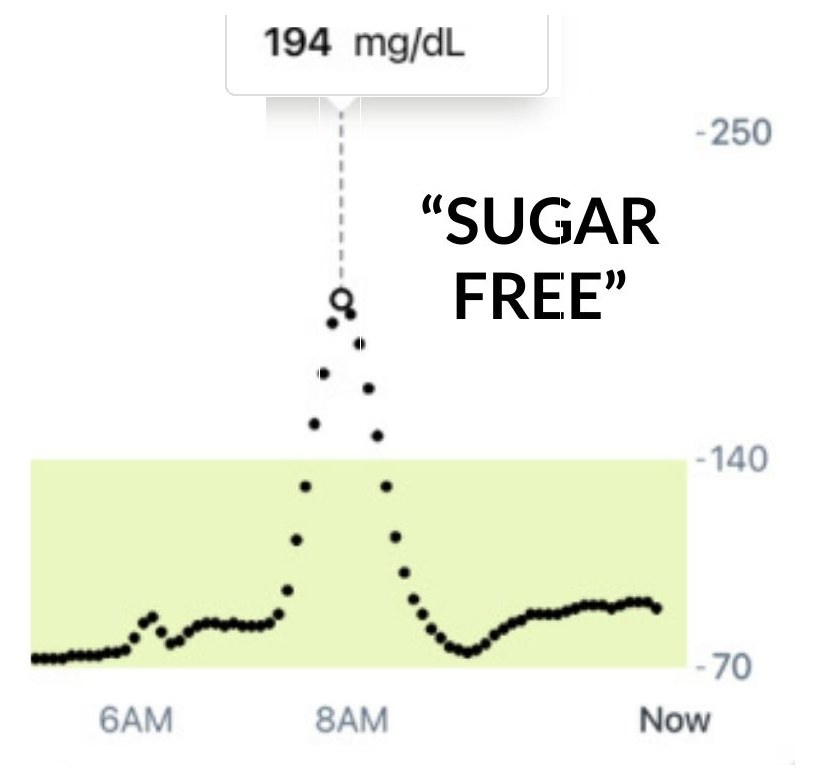
That was not what “sugar free” had led me to expect.
Milk has sugar of its own, so the first question was whether the milk alone could explain it. I ran the control: the same fairlife milk, on its own, on another morning. It did not come close to that curve.
So I did what I should have done first. I read the ingredient list.
Reading the label
The first ingredient was maltodextrin. The nutrition panel lists 12 grams of carbohydrate per two-tablespoon serving and 0 grams of sugars.
Maltodextrin is made from starch. Chemically it is a short chain of glucose molecules, and the body breaks it down quickly. Its glycemic index is usually listed at or near that of pure glucose, and above table sugar. But it is not a sugar in the labeling sense. In the United States, “sugar free” means a serving contains less than half a gram of sugars, and maltodextrin is not counted among them.
So the label was not lying. By its own definition, it was accurate.
It just answered a different question than the one I was asking. The label answered: how much sugar is in this? I wanted to know: what will this do to my blood glucose? Those sound like the same question. They are not, and the maltodextrin lived in the gap between them.
What one morning can and cannot tell you
This is the part where the scientist in me has to be honest about the evidence.
Comparing against milk alone was a real control, and it made the milk an unlikely explanation. The ingredient list then offered a likely one. But one morning with one sensor is still one observation. A continuous monitor measures glucose in the fluid under the skin, not in the blood itself, and it runs a few minutes behind. Sleep, stress, and the rest of the day can all move the line.
A stronger version would repeat each condition several times and add a known amount of real sugar as a comparison. That is how a striking observation becomes something closer to a finding. For a decision about my own breakfast, what I had was enough.
I wrote about this habit in How Science Taught Me to Be Wrong Productively: when you change one thing at a time, a surprising result can point somewhere. Keeping the milk the same and adding only the mix is that habit at the kitchen counter.
What I changed
The mix stopped being my morning default.
The more useful change was learning that the order of a meal matters, not just its contents. Jessie Inchauspé makes the case well in Glucose Revolution: eat fiber first, then protein and fat, and carbohydrates last. Fiber and fat slow how quickly carbohydrates are absorbed, which flattens the curve. My own readings were consistent with that. Salad first, dessert last. I did not expect meal order to be one of the most practical things I learned all year.
None of this means giving up things I enjoy. It means knowing what they do, and choosing how and when.
Why a chai belongs on this site
I do not write about health as a clinician. I am not one. I write about it because the same mistake shows up everywhere I look.
A label is a claim made by someone with a reason to make it. So is a projected return, a marketing deck, or a confident sentence at a dinner party. A claim can be true and still not answer your question. In investing, I read the projected return last for a similar reason: the number can be accurate on its own terms and still tell me little about what I actually need to know. I wrote about that in Why I Read the Return Last.
The fix is the same in both places. Decide what question you are really asking. Then look for evidence that answers that question, not a nearby one.
I still like chai. I just read the label differently now: not for what it promises, but for what it leaves room for.
Tim Fergestad, Ph.D., is a scientist and investor. He writes about seeing clearly, acting deliberately, and living gratefully at TimFergestad.com. He is the founder of Oak Street Assets and host of the Phoenix Prosperity Podcast.
This is a personal experiment, not medical advice. If you have a medical condition or are thinking about changing how you eat, talk with your doctor. Nothing here is investment, legal, or tax advice either.
Field Notes from Tim
Occasional, high-signal ideas, experiments, and things worth thinking about. I send it when I have something worth opening.
Your address is used for Field Notes and nothing else. Unsubscribe any time.