Legacy: How
The Eagle Kept Showing Up
Our family motto started as a sentence. Getting it down to three words taught me more than writing the original did.
A few years ago I wrote our family motto into an article about legacy: Fergestads work hard, speak truth and love deeply.
I still believe every word of it. I did not notice its limits until I tried to put it on something.
A motto that lives in an essay can be eight words long. A motto that has to fit on a banner under a crest, or be repeated by a teenager without rolling their eyes, has a harder job. Trying to shrink ours forced a set of questions I had skipped the first time: where the words come from, who they belong to, and whether anyone in the family would recognize themselves in them.
Stories before words
The first thing I learned is that you cannot start with the words.
My research career was spent on how neurons signal each other, not on how families remember things, so I will not dress this up as science. You do not need a lab to notice the difference anyway. Ask someone to recite their family’s stated values and they may struggle. Ask them about their grandfather and a story appears immediately.
Nobody in our family needs the word service defined. They have heard about my father, Jim, pulling over in pouring rain to help strangers with car trouble, fixing it, and refusing to take a dollar for it. They have heard about his father, my grandfather Herb, his Navy service in the Second World War, and the quiet way the neighborhood ended up looking to him. They know the generations before us were builders, masons and immigrants who made things meant to last.
Those stories already contained our values. The work was noticing which ones kept getting retold.
Five words, written as behavior
When we did that, five values kept surfacing:
- Energy. Effort, optimism and fun.
- Awareness. Pay attention. Stay curious.
- Gratitude. Appreciate what is already here.
- Love. Grace, compassion, service.
- Excellence. Ownership, integrity, work done well.
The order matters more than the definitions. Awareness comes first, because you cannot appreciate what you never noticed. Gratitude turns that attention into appreciation. Love turns it outward. Excellence is what acting on all of it looks like. Energy is the spirit you bring to the whole thing.
One clarification we made early, because it matters with kids: excellence is not perfection. A value that becomes a weapon has stopped doing its job.
The eagle kept showing up
Read the first letters down the page and you get EAGLE. That is our coreword: one word that carries the five values together. The idea of a coreword came from Fig & Eagle, a family coaching community we belong to and where we now serve as a mentor family. If you want more structure and company for this work than an essay can offer, start there.
I was suspicious of it at first, because acronyms are easy to force. But we did not choose the eagle because the letters worked. Eagles kept showing up in our family story. My high school mascot was an eagle. My son is an Eagle Scout and studies at a university whose mascot is the Eagle. And the image fits what we want for our kids: strong wings, and the courage to fly into wind rather than around it.
That became the test I would give any family symbol. Did you choose it, or did it keep choosing you?
Meaningful is not the same as shared
The eagle passed that test. What it told me was not quite what I first thought.
Look at the list again. My mascot. My son’s scouting. My son’s school. The first discovery was that the eagle was not arbitrary. The second was harder to see: meaningful is not the same as shared. The eagle is a real thread in our family story, but it is mostly two people’s thread. I had assumed that because a symbol meant something to me, it represented the family.
A family symbol that represents half the family is a personal logo.
So our everyday mark carries one bird that is part eagle and part raven. The eagle keeps what it already stood for. The raven carries Awareness, the value that starts the sequence, and reaches back to the Norwegian side of our heritage. It also comes from the other side of our family story: my wife and daughter had wanted a black cat for years, and when we finally got one, they named her Raven. One bird, with all four of us in it.
That was the third discovery: a family identity has to be recognizable to everyone inside it. Every symbol needs a reason to belong, and the reasons have to come from more than one person.
Three words
With the stories, the values and the symbols sorted, the motto almost wrote itself.
Rooted. Grateful. Growing.
Rooted is where we come from: ancestry, faith, home, family, and the people whose stories were handed down to us. Grateful is the present: noticing what is already here. Growing is the future: curiosity, courage, becoming more capable.
Past, present, future, in three words a ten-year-old can say from memory.
A family identity cannot only describe who you already are. It has to describe who you are trying to become. Rooted is inherited. Growing is chosen. EAGLE works the same way: part description of us on our better days, part standard we are still reaching for. That is what keeps it from becoming a museum exhibit of ancestors.
The older sentence did not go anywhere; it is still how we talk to each other. The three words go on the crest, with Stand Fast, the Clan Grant motto on my side, as a possible quiet echo underneath.
Recognition and storytelling
One last distinction took me the longest to see: a family mark and a family crest are different tools.
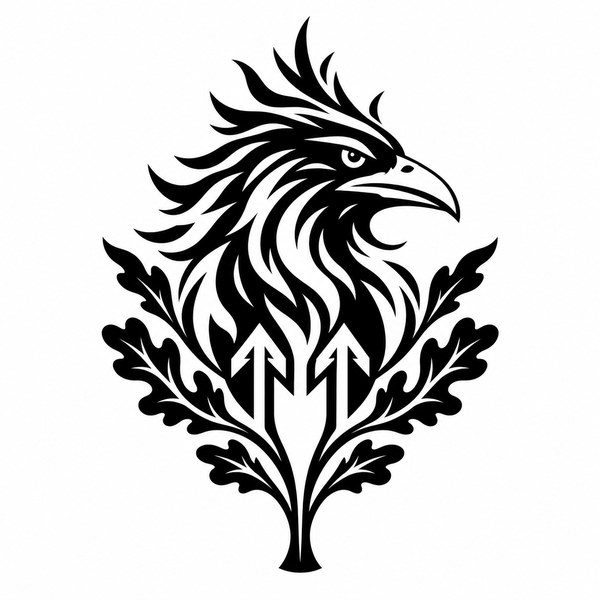
The mark is the simple version: oak leaves, that eagle-and-raven head, two arrows pointing up. It has to work in black and white on a hat, a pin or a wax seal. It is for recognition.
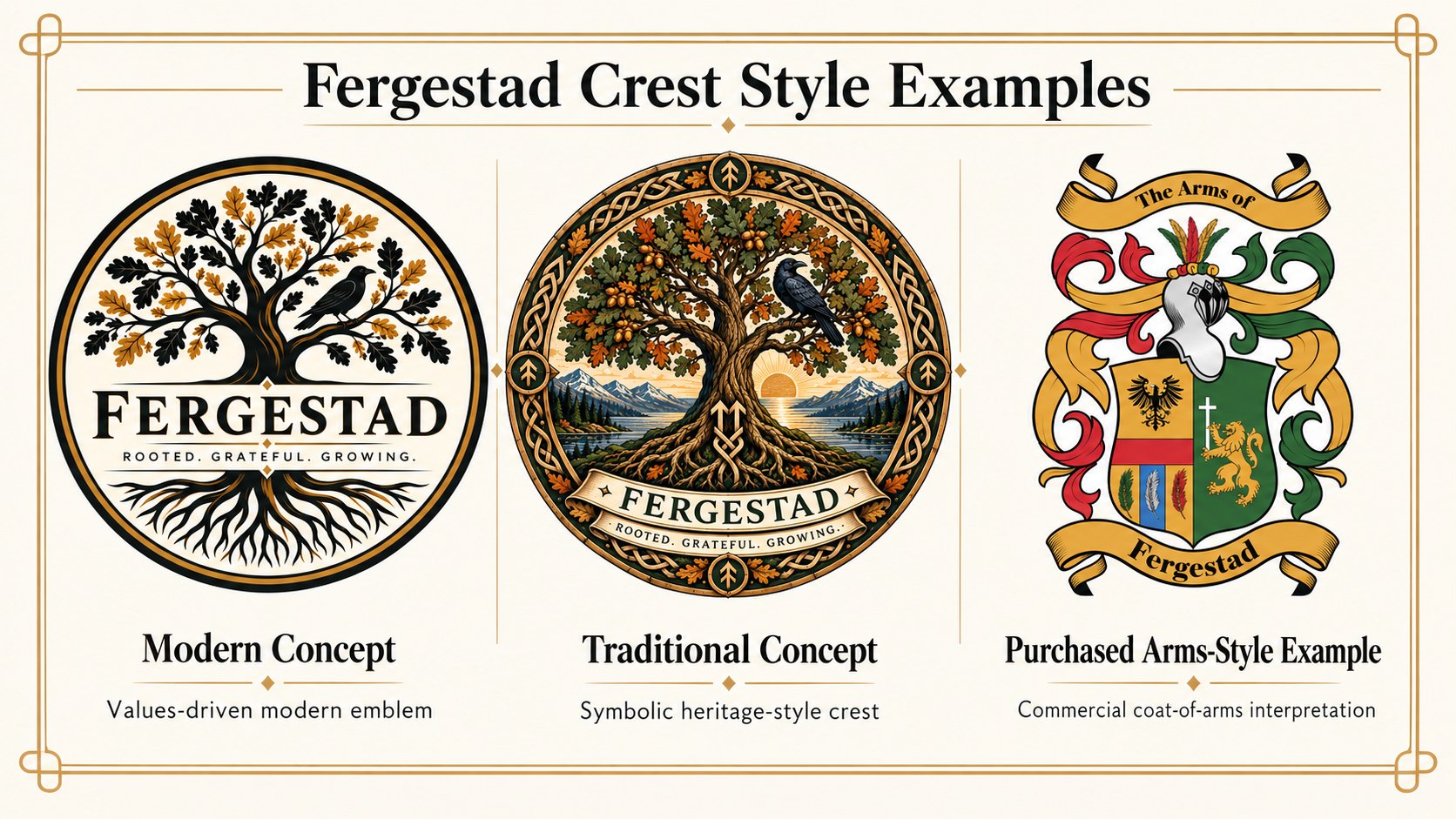
The crest is the richer version, with room for heritage colors, the motto, and details that need explaining. It is for storytelling.
Trying to make one image do both jobs is how families end up with something too busy to remember and too vague to mean anything.
What I would ask first
If I started over, I would not start with symbols, or even values. I would start with one question for everyone at the table:
If our kids remembered only three things about what our family stood for when they are forty, what would we want those three things to be?
The first versions of all of this came out of my notebook, which is the wrong place for a family identity to come from. The better versions came from letting other people’s answers change mine.
Families change, and a family identity should not try to freeze the next generation into a script. The point is to give them roots strong enough to know where they came from, and enough freedom to choose where they go next.
Tim Fergestad, Ph.D., is a scientist and investor. He writes about seeing clearly, acting deliberately, and living gratefully at TimFergestad.com. He is the founder of Oak Street Assets and host of the Phoenix Prosperity Podcast.
The Family Legacy Workbook walks a family through this same process, from roots to a credo and a crest of its own. It is free, with companion printables on the Resources page. The companion essay, on why it matters, is What Are You Actually Building Wealth For?
Field Notes from Tim
Occasional, high-signal ideas, experiments, and things worth thinking about. I send it when I have something worth opening.
Your address is used for Field Notes and nothing else. Unsubscribe any time.